How Do You Write an Audio Guide? A Guide
Whether at a museum or on a city tour, an audio guide promises visitors fascinating stories and background information on objects, places, and biographies. As a tour guide or museum staff member, however, you might wonder: How do you create an audio guide? We’ll offer practical tips and share our experience.
To develop a good audio guide, we need to clarify a few basic questions—for example, regarding the target audience , the educational approach, the structure, and the style.
Target Audience: An Audio Guide for Your Audience
First, we need to consider which target audience our audio tour should be aimed at. After all, it makes a difference whether we want to create an audio tour for children, adults, or tourists. Perhaps an accessible tour for people with visual or hearing impairments would also be a good idea? In which languages would we like to offer the audio guide?
Help Finding a Good Audio Guide
Museum guides are typically aimed at a broad audience. The content reflects the current state of scientific knowledge but highlights the most relevant aspects and is presented in a way that is accessible to a general audience. Connections to the present day and the listeners’ everyday lives, as well as the famous “common thread,” foster relevance and understanding. Visitors appreciate knowing the perspective from which the information is presented: For example, is the speaker an expert in curation, restoration, or architecture? In any case, we recommend clearly identifying personal interpretations as such.
Structure for a Good Listening Experience
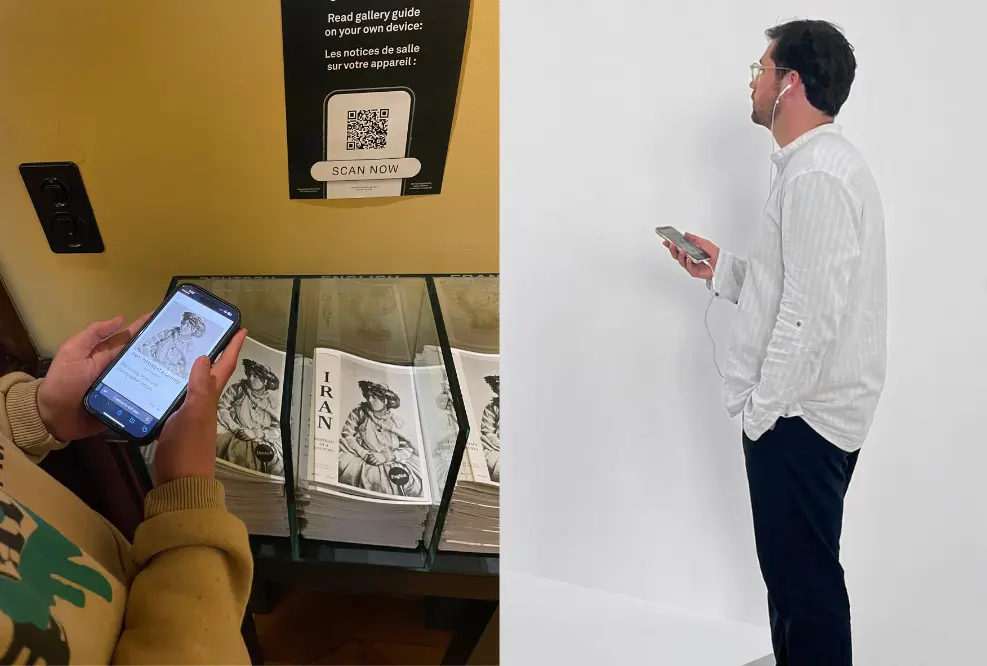
Ideally, the design of the audio guide should be integrated into the exhibition process at an early stage. This not only ensures that there is enough time, but also allows relevant connections to develop between the exhibition content and the audio guide’s content. Is one chapter planned per room, or will the focus be on selected highlights? Should it be a cohesive “tour,” or should the emphasis be on individual fragments and objects? Do we guide visitors and provide precise directions, or do listeners independently choose which objects interest them? With Audio-Cult, both are possible: a cohesive guided tour as well as an object-based audio guide. Using a QR code, visitors can access the entire tour or a single artwork.
Length: Consider the optimal attention span
The audience expects a concise summary. That’s why we recommend 90 seconds as a guideline for individual audio chapters. If it’s not possible to shorten the text, consider dividing it into several audio tracks. Even the general introduction or broader context should not exceed 1.5 to 2 minutes. As a rule of thumb, 120 words correspond to about 60 seconds of audio.
Style: Effective Teaching Methods
Next, it’s worth defining the narrative style for the audio tour. People remember stories more than they do facts. This isn’t just about conveying information; it’s about storytelling and entertainment. Should listeners be guided in a playful or documentary-style manner? Does the narrator’s voice allow for a subjective perspective? Should the narrator’s personality shine through, or do we want to maintain a neutral tone? These stylistic questions naturally depend on our content, the defined target audience, and the narrative approach. Incorporating music, soundscapes, quotes, and original recordings further stimulates the listeners’ imagination. One thing is clear: an audio guide can be monological and matter-of-fact. But we can also develop dialogic elements or even a story with the character of a radio play. In any case, the script should allow for logical trains of thought and associations. Ideally, there is a central theme that we refer to repeatedly.
Practical Tips: How to Create the Perfect Audio Guide
How do I create an audio guide? Even during the writing process, it’s worth saying the sentences out loud to ensure that auditory comprehension is a priority from the very beginning. Here are a few selected practical tips and examples:
Active verb forms: ensure clarity and dynamism—this brings the text to life.
❌ “Thepainting is being painted.”
✅ “Picasso is painting the picture.”
Engaging the audience: use questions to stimulate and encourage reflection.
✅ “Look up—what do you see?”
✅ “What do you think—why did the artist copy the work?”
✅ “Why is the panda bear actually called a panda bear?”
Foreign words and technical terms: avoid or explain.
❌ “eloquent”
✅ “articulate.”
❌ “get worked up,”
✅ “get upset.”
❌ “coherence”
✅ “connection.”
Nouns: Replace with active verb formswhenever possible.
❌ “Registration for the tour takes place online”
✅ “Register online for the tour”
Jumps in thought: Avoid them and ideally limit yourself to one idea per sentence.
Years: Use sparingly and only when necessary or helpful.
Sentence openings: Establishlogical connections at the beginning of sentences (therefore, so, because,...)
Sentence length: Keep sentencesas short as possible. Ideally, no more than 10–15 words.
Sentence structure: Create variety through different sentence structures.
Sentence endings: Placethe main points at the end of the sentence—this helps listeners remember what they’ve heard.
For questions and editorial support, contact Wonnder (formerly Audio-Cult)! We’re happy to share our experience, best practices, and guidelines for museum guides. Upon request, we can also handle content creation and production.